
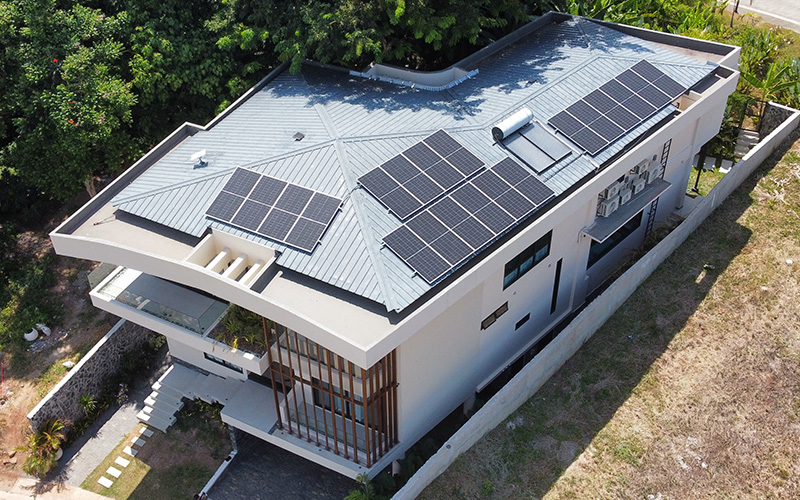
The right solar system for your home starts with your electricity consumption in kilowatt-hours (kWh), not just the amount you pay each month. A household using 600 kWh over 30 days, for example, consumes an average of 20 kWh daily. Under an illustrative solar energy yield of 4 kWh per installed kilowatt-peak (kWp) per day, a 5 kWp solar array would generate approximately that much energy. However, the best system size for that household could be smaller or larger depending on its daytime loads, roof and backup requirements.
If you are comparing solar packages in the Philippines, this guide will help you understand the numbers on your quotation and avoid paying for capacity that does not match your needs.
1. Start with the kWh on your electricity bill
Whether your electricity comes from CEPALCO, Meralco or another distribution utility, look for the actual energy consumption shown on your bill. A ₱10,000 bill alone does not tell your installer how much electricity you consumed. Rates can change, and the amount due may include adjustments, fixed charges or an unpaid balance.
Ideally, gather twelve months of bills so you can see both your typical consumption and seasonal peaks. Add the consumption figures and divide by the number of billing days covered to estimate daily energy use. If you have recently added an air conditioner, water pump or electric vehicle, tell your installer so future demand is not overlooked.
For a simple 30-day example, 300 kWh per month means 10 kWh per day, while 900 kWh means 30 kWh per day. These figures describe energy consumed, not the maximum electrical power required at any instant.
2. Estimate how many kilowatts of solar panels you need
Solar panels are rated in watts-peak (Wp) or kilowatts-peak (kWp). An array’s rating is its nominal DC capacity under standard test conditions. Actual energy production depends on sunlight, temperature, shading, orientation, inverter efficiency and other system losses.
Preliminary array size (kWp) = target daily solar production (kWh) ÷ estimated daily energy yield (kWh per kWp).
The examples below assume a net yield of 4 kWh per installed kWp per day and a 30-day billing period. This is a planning assumption, not a measured average for your property or a guaranteed production rate.
| Monthly usage | Daily usage | Illustrative PV capacity | 600 W panels (rounded up) |
|---|---|---|---|
| 300 kWh | 10 kWh | 2.5 kWp | 5 |
| 600 kWh | 20 kWh | 5 kWp | 9 |
| 900 kWh | 30 kWh | 7.5 kWp | 13 |
| 1,200 kWh | 40 kWh | 10 kWp | 17 |
Panel counts are rounded up for illustration and are not final string designs. An installer must confirm roof fit and inverter electrical limits. Matching your daily energy use with daily solar production also does not guarantee a zero electricity bill: electricity may be needed at night or exported during the day.
For more background on how equipment and site conditions affect energy production, refer to the U.S. Department of Energy’s overview of photovoltaic system design and energy yield.
3. Check when your household uses electricity
Imagine two homes that both consume 600 kWh per month. In Home A, air conditioning runs during office hours because the occupants work from home. In Home B, the family is away during the day and uses most electricity after sunset. Both homes have the same monthly energy consumption, but Home A may use a greater share of its solar generation directly.
Suppose Home B uses only 8 of its 20 daily kWh during daylight. A 5 kWp array generating an illustrative 20 kWh that day could produce more energy than the home can immediately use. Without suitable storage or approved export arrangements, some of that generation may be curtailed or have limited financial value.
This is why a load profile matters. Ask your installer to assess when your air conditioners, refrigerators, laundry equipment and pumps operate. If convenient, shifting flexible loads such as laundry or water pumping to sunny hours can increase direct solar consumption without adding battery capacity.
4. Understand the difference between inverter size and panel size
A quotation may list a 5 kW inverter and a 5.4 kWp panel array. These two numbers refer to different components: the inverter’s AC output capacity and the panels’ nominal DC capacity. Nine 600 W panels total 5.4 kWp.
A designer must check maximum PV input voltage, operating current, MPPT limits, permitted DC capacity and the expected losses from inverter clipping. The right ratio depends on the actual inverter model and installation conditions. Do not assume that every inverter of the same nominal rating supports the same number of panels.
The solar photovoltaic system design overview explains the different roles of panels, mounting systems, inverters and storage.
5. Decide whether you need battery storage
If your main objective is reducing your electricity bill and you consume plenty of energy during the day, a grid-tied system may be worth evaluating. If you also want backup during brownouts or greater use of solar electricity after sunset, a hybrid system with batteries may be more appropriate. A conventional grid-tied system normally stops supplying the home when the utility grid fails; backup requires suitable inverter equipment and a dedicated backup arrangement.
Estimate battery energy separately from panel capacity. For example, selected essential appliances averaging 500 W over six hours require 3 kWh of delivered energy. If the usable battery fraction is 80% and the conversion efficiency is 90%, the illustrative nominal capacity required is 3 ÷ (0.8 × 0.9), or about 4.17 kWh, before adding further reserve. Actual specifications and backup duration vary.
A battery’s kWh capacity determines how much energy it stores, while its discharge power and the inverter’s backup output determine which appliances can run simultaneously. Motor starting demand may require additional capacity. Tell your installer whether you want to back up essential circuits or your entire home.
Compare the options in our guide to grid-tied, hybrid and off-grid solar systems.
6. Assess your roof before choosing a package
Roof dimensions alone are not enough. A site assessment should account for shading from trees or nearby buildings, usable roof sections, access paths, mounting requirements, structural condition and electrical routing. In Northern Mindanao, as elsewhere in the Philippines, the installation also needs suitable design for local wind and weather exposure.
Check the roof’s remaining service life before installing panels. If repairs are needed, coordinating them before installation can reduce the need to remove and reinstall equipment later. Ask for a proposed panel layout and a site-specific generation estimate, not merely a package based on your bill.
7. Estimate savings realistically
If solar supplies 300 kWh that you would otherwise have purchased from the grid, and your assumed avoidable electricity cost is ₱12 per kWh, the illustrative avoided cost is ₱3,600. This is a worked example, not a current utility tariff or a guaranteed saving.
Actual savings depend on direct consumption, approved export credits, battery losses and utility charges. If you plan to export excess electricity, ask your distribution utility about its current net-metering requirements and credit calculation. Our net-metering guide provides additional context.
Frequently asked questions
Is a 5 kW solar system enough for a Filipino household? It depends on daily consumption, available solar production, timing of electricity use and backup needs. A 5 kW inverter rating alone does not tell you the array’s expected monthly generation.
Can I install a small system first and expand later? Potentially. Discuss the planned expansion with your installer so the inverter, roof layout, electrical equipment and applicable approvals can accommodate it.
How many panels do I need for a ₱10,000 bill? Find the kWh consumption and billing days first. Then assess daytime loads and roof conditions. A quotation based on the peso amount alone is only an initial estimate.
Get a solar system designed for your home
Prepare recent electricity bills, your property location, roof photos, major appliance list and desired backup duration. At Solar Up Philippines, these details help us recommend a system that matches your household’s actual energy needs and budget.
Explore our solar financing options if you prefer to spread out your investment, subject to eligibility and terms. Book your solar consultation with Solar Up Philippines to discuss your system requirements.